By Josh Hoang-Wilkes in Domino Theory
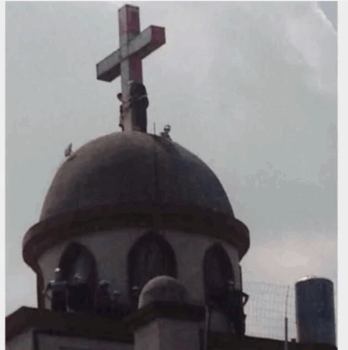
On the night of December 14, over 1,000 police officers surrounded Yayang Church in Wenzhou, Zhejiang. At 3 a.m. they burst into the church “with extreme violence.” Over 100 adult members of the congregation who had chosen to remain inside were arrested; those with children had left earlier in the evening. The police put black hoods on the congregants and took them away.
From December 13 to December 17, Christians in Yayang were detained in a large-scale operation, according to Bitter Winter, a magazine that covers religious liberty and human rights in China. This included but was not limited to the detentions at the church itself. The total number detained is unclear. Authorities accompanied this crackdown with a firework display in the town square on December 15 that drew attention from outside.
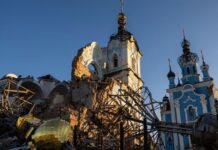
On January 6, footage showed that scaffolding had been erected around Yayang Church, bringing the story to a wider audience, and by January 10 it was reported that the cross atop the church had been removed. As of January 10, Christian watchdog ChinaAid reported that 20 individuals had not been released.
But this is not the only incident of Christians in China being persecuted this month alone. On January 6, nine prominent individuals from Early Rain Covenant Church, including church leader Li Yingqiang (李英強), were arrested and taken into custody. According to information released by the church on January 15, at least seven individuals are currently either detained or out of contact with their families. This is part of a much larger and ongoing crackdown on Christians and other religions in China under President Xi Jinping (習近平).
Yang Fenggeng (楊鳳崗), a sociologist who studies Christianity and religion in China, has a model of how religions there are allowed to operate. There is a “red market” of state-sanctioned religions and a “black market” of illegal religions. In between is what he describes as the “gray market,” religions or religious organizations that are not legally recognized, but were somewhat tolerated by authorities.
For Protestantism, the red market is managed by the Three-Self Patriotic Movement, a state body that is answerable to the United Front Work Department of the Chinese Communist Party, an organ that operates to increase the party’s influence inside and outside China.
The Three-Selfs refers to a church that is “self-sustaining, self-propagating and self-governing,” according to Carsten Vala, a political scientist who wrote a book on Protestantism in China. Three-Self churches can’t have a distinctive denomination such as Presbyterian because they can’t maintain official ties with external groups. These official churches also use state-sanctioned translations of the Bible, display state iconography inside church buildings, and preach to state-approved themes. “God has put people in authority with the sword for a certain reason,” is an example Vala gave me of this kind of messaging.
Because of their “official-political role,” Three-Self churches “cannot fully meet believers’ religious needs,” said Ying Fuk-tsang (邢福增), a historian at Academia Sinica. The number of Three-Self churches is restricted, he wrote to me in an email, which results in a shortage of officially recognized religious venues.
Perhaps surprisingly, these official churches are not immune from persecution, even though they are effectively government-run. However because of that relationship, the government and party already has its way the vast majority of the time.
The churches that have been in the news this month, Early Rain Covenant Church and Yayang Church, are both unofficial churches. They are not part of the Three-Self Patriotic Movement and would previously have been understood to be inside Yang’s gray market. But perhaps no longer.
Unofficial churches are often called house churches. This comes from the practice that many still follow of meeting in small numbers in private homes. But for those of us who are unfamiliar with this topic, this can be misleading, as many unofficial churches, including those in this article, meet in large numbers outside of private homes.
Early Rain Covenant Church is nonetheless an example of what Yang described to me as a “new urban house church.” He explained that what distinguishes these from other unofficial churches is that they openly refuse to join the Three-Self movement, but at the same time when they were founded they wanted to register with the government as a religious organization. They persistently invited local police and religious affairs bureau officials to come to their worship service, Yang said. “We welcome you to come here, see what we do.”
These new urban house churches had a “vision that churches should not only be serving the needs of the congregants, but that they should also be welcoming and influential in society,” according to Vala. “They were really pushing the envelope … they were seeking to be visible in society.”
The congregation of Early Rain Covenant Church is not confined to Chengdu, where it was founded, but is dispersed around China, according to Anita Chang (張安安), director of Global Missions at ChinaAid. Early Rain Covenant Church holds an online Bible study session called “Five p.m. in China” that anyone can log on and join. The church has adopted the strategy of actively publicizing the government’s persecution. This has made information about it relatively accessible outside of China.
The founder of Early Rain Covenant Church, Wang Yi (王怡), was sentenced to nine years in prison in 2019 for “inciting subversion of state power.”
There are a number of other new urban house churches. Many of them have received similar persecution from the Chinese government. The most recent example is the Zion Church, which was based in Beijing. Thirty members of Zion Church were detained in October 2025, including pastor Ezra Jin Mingri (金明日). Eighteen were later formally arrested. Zion Church has lacked a church building since 2018 when it was closed in a previous crackdown.
Yayang Church is of a very different kind. Vala called it “third strain,” distinguishing it from both the Three-Self Patriotic Movement and other unofficial churches. The church is located in the city of Wenzhou, often described as “China’s Jerusalem” because of the large number of churches and Christians who live there. It is part of a larger local movement of churches called the Little Flock.
It is very uncommon nationally for house churches to have a church building, Yang told me. But in Wenzhou, there are many such cases. These churches “do not openly refuse to join the Three-Self Patriotic Movement,” Yang said, but they nonetheless distance themselves from it. He considers them to be a mix of red and gray markets, by his own theory.
Little Flock churches are very apolitical. In contrast to Early Rain Covenant Church, Yayang Church has not publicized what is happening to it. That information has gotten out in part because of the decision by the local government to draw attention to their crackdown with the rather grim fireworks display.
Because there is less direct communication from the Yayang Church itself, it’s not totally clear how its experience differs from other churches in Wenzhou. However, Yang’s understanding is that the local government has managed to coerce most churches in Wenzhou to hang the Chinese flag inside and to accept government surveillance cameras that watch the minister and congregation during services.
ChinaAid interviewed a person it identified as “Brother W” who shared details of the persecution of Yayang Church that started in December. He said that Yayang Church is the only church to remain standing in the fight not to display the national flag.
The different strategies of the two churches in how they face their persecution appear to be rooted in their origins and their broader strategies for trying to maintain their independence within China. Early Rain Covenant Church attempted to be radically transparent, Yayang Church attempted to lay low. In the end, neither seems to have succeeded.
New urban houses churches like Early Rain Covenant Church have faced these crackdowns because their modus operandi, being active in broader society, is inherently threatening to the Chinese Communist Party. Because they are fewer in number, targeting them is also more practical for the authorities.
It seems that Yayang Church, in refusing to comply, became the nail that stuck out, and was perhaps unlucky that a local official was particularly enamored of his hammer. But it’s also true that the outside world has far less visibility onto churches like Yayang, so we may simply not know about other cases.
It is easy to approach this topic and conclude that what is happening to these two churches is either widespread, or that they are isolated cases. In reality, likely neither is true. Both churches are exceptional in different ways, but their persecution stems from top-down decisions and policies.
In 2018, China introduced new legislation that Bitter Winter editor Massimo Introvigne described as attempting to “eradicate” the gray market for religions, forcing churches into the red or black. And as Vala pointed out to me: “There’s constant pressure being applied that won’t make the news.”
This “Sinicization” of religion campaign under Xi extends beyond Protestants to Catholics, Muslims and even Buddhists, according to Yalkun Uluyol, the China researcher at Human Rights Watch, who has been tracking all these incidents. Repression now is the strongest it’s been for decades, Paul Marshall, a senior fellow at Hudson Institute’s Center for Religious Freedom, informed me via email.
The normal human reaction to these stories, and the many others like them, is to say that the Chinese Communist Party is immoral because it does not allow its citizens religious freedom.
But I think it’s worse than that.
If the Chinese Communist Party can’t tolerate people who want to make a positive contribution, or even those who simply want to be left alone with their faith, it is not intolerant; it is incontinent. If it can’t help itself, it can’t help society.
To completely butcher Lincoln: No-one can govern all of the people all of the time, but you have to be able to govern all of them some of the time. The Chinese Communist Party has shown itself unable to govern these Christians, and thus, it cannot govern. — ChinaAid