According to a report published earlier this year by Mission Eurasia, a parachurch ministry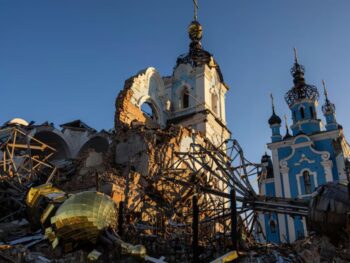 dedicated to equipping churches in and around Ukraine, Russian forces have damaged or destroyed at least 737 religious buildings since the start of the full-scale invasion in 2022.
While the majority were churches, mosques, synagogues, and other religious sites were attacked as well.
Of the 737 buildings affected, about 450 were Baptist churches. Baptists, while the largest evangelical population in Ukraine, represent only 1% to 2% of the overall population, suggesting that Russian forces may be deliberately targeting Baptists in their violent campaign across Ukraine.
One widely reported case involved Baptist Pastor Sergey Ivanov, who served a congregation in occupied southern Ukraine. According to church networks and human rights monitors, Russian forces detained Ivanov after accusing him of cooperating with Ukrainian authorities and refusing to register his church under Russian regulations.
Members of Ivanov’s congregation reported that services were disrupted, and the church building was effectively shut down while the pastor was interrogated. The case reflects a broader trend of pressure on Baptist and evangelical communities, many of which have refused to submit to occupation-imposed oversight of religious activity.
In some cases, however, the destruction may be incidental. Speaking to the Baptist Press, Igor Bandura of the Ukrainian Baptist Union highlighted the broad destruction created by invading Russian forces.
“Everything is destroyed,” he said. “Not only churches, but villages, towns, cities, everything is destroyed. So, life is not there. Everybody left, and everything is destroyed.”
At times, the Russian aggression is focused on churches within the Orthodox Church, which is the main denominational persuasion in the country. Throughout the war, the Russian Orthodox Church has sought to leverage its authority over the Ukrainian Orthodox Church, prompting many denominations to defect to the independent Ukraine-based Orthodox Church of Ukraine.
Russian officials have openly co-opted structures tied to the Ukrainian Orthodox Church, a body historically connected to the Russian Orthodox Church. Analysts say that in occupied areas, the church has increasingly been used as a vehicle for political messaging and administrative control, blurring the line between religious life and state policy.
Critics argue that Moscow’s approach represents a blatant co-option of religious institutions to legitimize its authority over occupied territory. While many Orthodox believers in Ukraine worship independently of politics, occupying authorities have promoted clergy aligned with Moscow and marginalized or removed religious leaders who express loyalty to Kyiv.
In Crimea, priest Serhii Mykhalchuk of the Orthodox Church of Ukraine reported repeated harassment and legal pressure from Russian authorities following the peninsula’s annexation.
Courts ordered the eviction of his parish from its cathedral in Simferopol, and authorities seized church property after the community refused to re-register under Russian religious laws tied to Moscow’s ecclesiastical structures.
In other documented cases, Russian troops have invaded Orthodox churches to intimidate and humiliate priests. In one case cited by the Baptist Press, an Orthodox priest was stripped naked, beaten, and paraded through the streets with soldiers taunting him and asking, “Where is your God now?”
The priest survived the attack and later switched allegiance to the Orthodox Church of Ukraine.
Advocates for religious freedom say the pattern reflects a broader campaign to eliminate an independent civil society and replace it with institutions loyal to Moscow. Protestant communities — long active in humanitarian aid and community outreach in Ukraine — have drawn particular scrutiny from occupation authorities who often accuse them of being linked to Western governments.
Human rights monitors warn that the result is a narrowing of religious freedom across occupied areas of Ukraine. Churches unwilling to cooperate with occupation officials face harassment, closure, or expulsion, while religious structures perceived as supportive of Russian governance are given preferential treatment.
As the war drags on, faith leaders say the targeting of churches reflects a wider attempt to reshape Ukrainian society under Russian control. Observers note that the fate of religious communities in occupied territories will remain a key indicator of the broader human rights situation as the conflict continues. — International Christian Concern